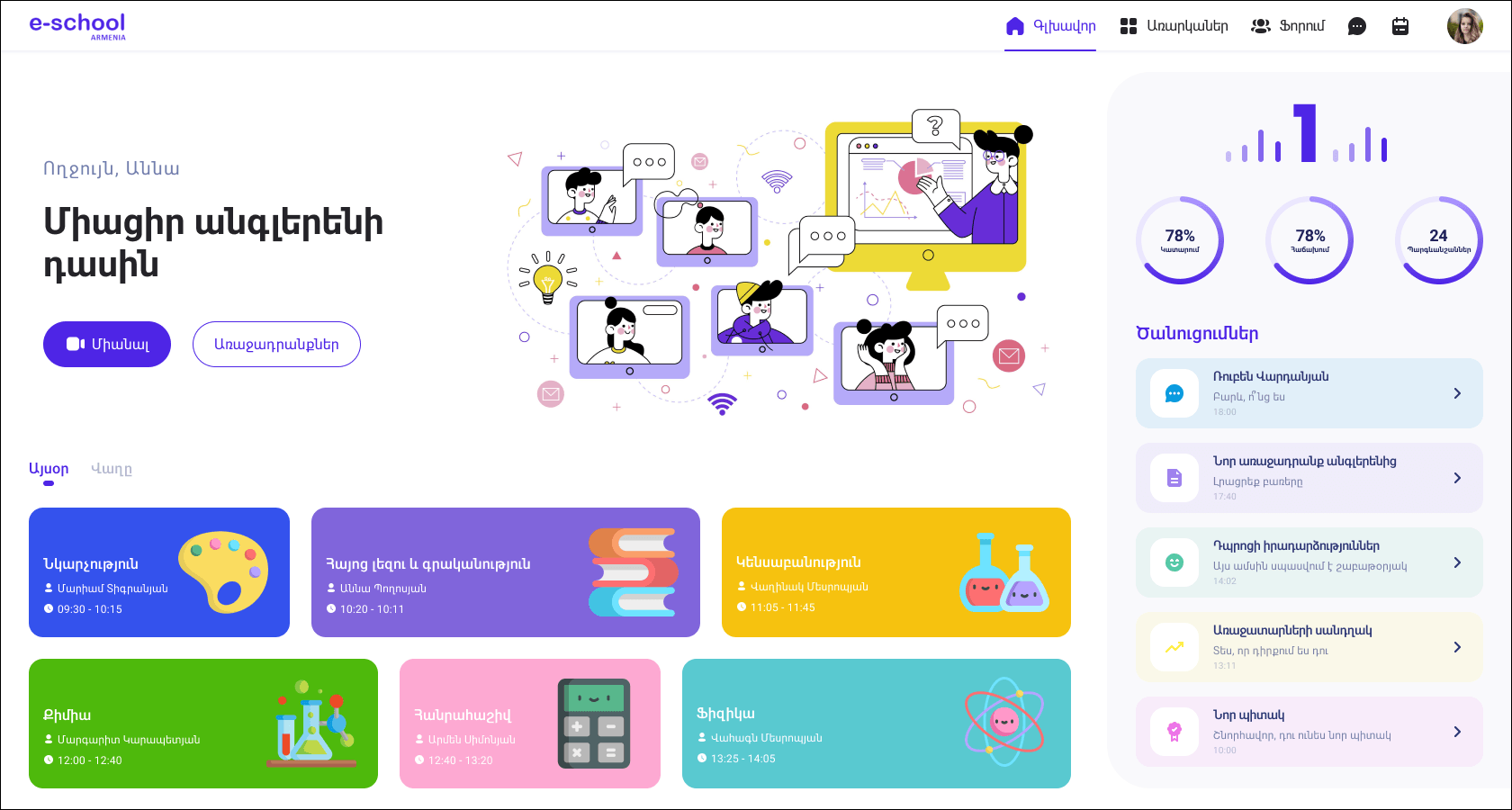
E-School: Distance Education Resilience Project

We are excited to share the good news of "E-school Armenia's" launch! A project Tutor Platform developed in cooperation with Future Solutions Armenia, Asian Development Bank and The Ministry of Education, Science, Culture and Sports of the Republic of Armenia.


The idea was to create a platform that would help build resilience towards outside events and obstacles that might work against the continuous nature of learning. The platform now allows participants to continue teaching and learning, even when faced with lockdown, like the case was with Covid-19. The platform is also helpful for learners with mobility issues, as well as learners who have no schools nearby.


The distance education resilience project aimed to develop a distance learning platform, make legislative and institutional improvements, build capacity and develop corresponding content. The efforts resulting in the project's year-long completion encompassed the analysis of current legislation, numerous meetings with mentor-school directors, NCEDI, NCET and MESCS representatives.


80 teacher-ambassadors and 18 mentor-schools were trained on how to use the distance learning platform, so that they could, in turn, help and train others.Our teammates Kima Ghulyan and Armen Meloyan, being the Tutor Platform's representatives, conducted over 15 trainings on how to effectively use the newly developed software in its full capacity. The Tutor Platform team of Hovhannes Babayan, Anna Simonyan, Davit Davtyan, Vahe Zhamharyan and Lusine Mirumyan, led by Aram Karapetyan worked day and night to make this project come to life.


Software trial was conducted with 31 students, 10 teachers, 4 school managers, 4 content developers and 10 caregivers, and was followed by launch on 18 March.


Some of the features we are very proud to introduce through this project:


  • Teachers can now provide feedback to learners through notes
  • Learners can see all courses available and search through them
  • A course portal that allows learners to view all available courses through filters and search tools
  • Leaderboards - learners can now see how well they and their peers are doing
  • Learning path – A learning path was developed to give visibility and control over one’s own learning progress
  • Learners can now get badges for various achievements
  • History and reports on user's learning and actions
  • Cross school learning
  • Teacher training, rating and monitoring tools
  • Analytics - interactive learning, projects, live sessions, attendance, and grades are now collected into a single location. Collected data will improve e-learning materials, teacher and learner activity and behavior
  • User avatars, survey tool, test generator, themes, forum and handwriting, among many other features
  • E-school is now also integrated with Microsoft Teams, Zoom and EMIS


Our team looks forward to challenges and we can't wait to share more about our exciting new projects.
By Mariam Danielyan January 5, 2026
What 2025 Taught Us About Building Digital Learning When we look back at 2025, what stands out most isn't a single feature launch or milestone. It's how much our understanding of digital learning changed by working closely with educators, managers, and learning teams. This year wasn't about building faster. It was about building more honestly, based on how teaching actually happens. What follows is a reflection on what we learned, what surprised us, and how those lessons are shaping the future of Tutor Platform. Why We're Looking Back at 2025 In education technology, there’s a constant push to move forward: new tools, new features, new promises. But meaningful progress requires pause; moments to reflect on what’s working, what isn’t, and why. For Tutor Platform , 2025 was a year where assumptions met reality. We didn’t just ship product updates. We worked side by side with educators as they tried to move their learning materials, assignments, and workflows into a digital environment. And through that process, we learned that digital learning isn’t primarily a technical challenge. It’s an operational one. Looking back at the year helps us make sense of that shift — and share what building with educators has taught us. Digital Learning Starts With Teachers, Not Tools Much of the conversation around digital learning focuses on learners: engagement, accessibility, and outcomes. These are all critical. But 2025 reinforced something fundamental for us: If a digital learning experience doesn’t work for teachers, it won’t work for learners either. Teachers are the ones preparing materials, updating content, reviewing assignments, and responding to questions. When their workflows are fragmented or overly complex, the learning experience downstream suffers — no matter how polished the platform looks. This insight directly builds on what we explored earlier in Designing E-Learning for Everyone. Inclusive and effective learning design isn’t just about who can access content — it’s about who can manage it without burning out. In 2025, we saw firsthand how much invisible work sits behind every lesson. And we realized that improving teacher experience isn’t a “nice to have.” It’s the foundation. Content Became the Biggest Bottleneck One of the biggest surprises this year was where most of the friction lived. It wasn’t in teaching itself. It wasn’t even about using new technology. It was in managing content. Most institutions we worked with already had good materials: books, PDFs, presentations, exercises, and notes built over the years. The challenge wasn’t quality — it was structure.
By Mariam Danielyan December 22, 2025
Behind the Scenes: From Books to Digital Learning In our previous blog, "Designing E-learning for Everyone," we explored what makes digital learning truly work - accessibility, clarity, flexibility, and thoughtful design for different types of learners. This article is the next chapter of that story. Over the past few months, we’ve been working closely with one of our clients - a school with a dedicated group of teachers to help them move from printed books and scattered PDFs to a single, structured digital learning environment using Tutor Platform. What follows is not a polished success story, but a real behind-the-scenes look at what it actually takes to digitalize learning materials in a way that supports teachers, students, and managers alike. The Starting Point: When Learning Materials Live Everywhere Before the transition, the school's learning content was spread across multiple formats and tools:
By Mariam Danielyan November 19, 2025
Inclusive, Accessible & Mobile-Ready Education
Show More